The Sweet Smell of Success
After the civil war that followed on the heels of the War of Independence in the early 1920s, Ireland’s economic situation was dire. As part of the United Kingdom, little investment had been made in Ireland’s industrial development, especially in the part of the country that would become the Republic of Ireland. The poverty-stricken nation had few natural resources and was heavily dependent on an inefficient farming economy. Yet, 100 years later, Ireland has the highest GDP per capita in the world. What sparked this transformation? A sweet revolution.
The Sugar Factory
In 1925, a local businessman proposed the establishment of a Sugar Beet factory in Carlow, in the southeast of Ireland. Consulting with a Belgian company and receiving government support, Edward Duggan and his team broke ground within months to establish Ireland’s first large-scale sugar production facility on the Athy Road. The enterprise created industrial jobs for locals, supported a cash crop (beet) for farmers across the country, and produced a much sought-after, home-grown consumer product for the people of Ireland to sweeten their tea.
The factory’s success drove the nationalization of the industry and the creation of three more plants in Mallow, Thurles, and Tuam. These factories provided tens of thousands of jobs and turned out millions of tons of sugar over eight decades, from 1926 to 2006. It was the first industry of the Irish Free State—and a bold example of a nation forging its future from almost nothing.
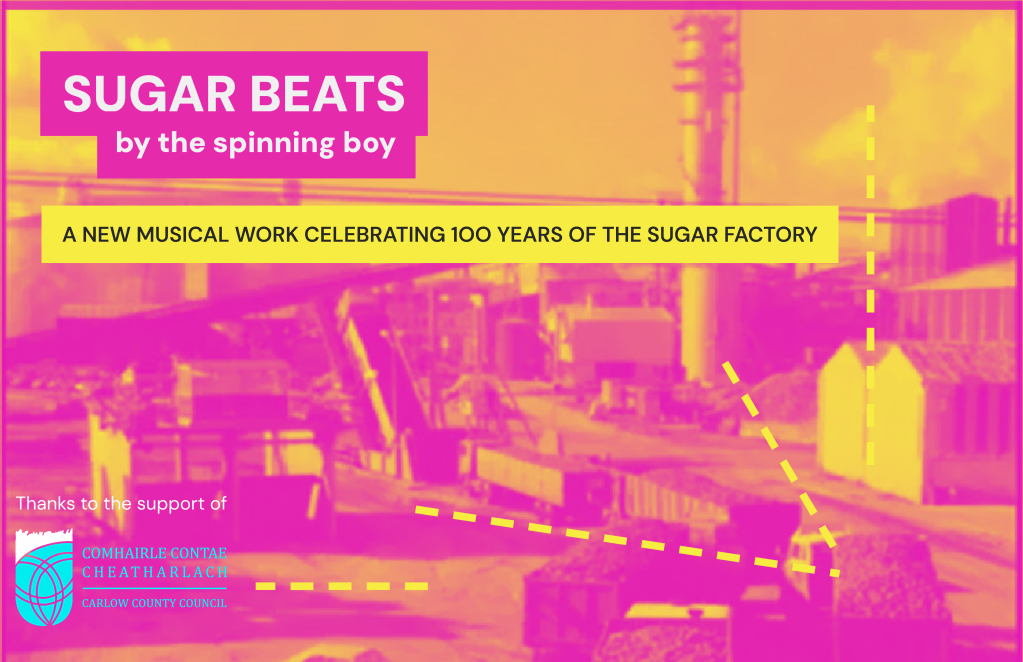
SUGAR BEATS
To celebrate the centenary of this heroic act of national development, THE SPINNING BOY has been commissioned to compose SUGAR BEATS, a 40-minute musical piece and accompanying film supported by an Arts Act grant from Carlow County Council Arts Office.
The music is performed using a combination of acoustic instruments, digital loops, and signal-manipulation hardware. This approach is known as “dawless” music production (DAW: Digital Audio Workstation), meaning no computer will be used. Guitar playing will be processed through delay sampling, distortion pedals, and tapes of voice and field recordings will be similarly manipulated. Live percussion is used, though traditional drums are supplemented by found objects and industrial paraphernalia played rhythmically. Drone makers and analogue synths are added to complete the soundscape.
The music is influenced by the genre known as Krautrock. Krautrock emerged in Germany in the 1960s and ’70s and was characterized by improvisation and hypnotic, minimalist rhythms. It is experimental, yet it also has a strong groove. This style references the European—specifically German—influence on the establishment of the sugar industry in the 1920s with the arrival of German-trained engineers, as well as the evolution of European Union policy that ultimately led to the industry’s demise. The 1960s and ’70s were also the high point of the industry’s development, marked by the rise of processed food and the creation of the spin-off company Erin Foods. This era represented the zenith of the futurist, utopian dream promised by modernization.
Out of the Strong came forth Sweetness
The relevance of the electroacoustic approach lies in its ability to reflect the liminal nature of the burgeoning sugar-manufacturing enterprise. This was a modernist endeavour, yet it was built in an environment that had virtually no technology. Men used physical labour and hand tools to construct the factory, and the beets were pulled by hand. It took hundreds of workers to operate the factory and thousands more to grow the crop. The entire project embodied the ambition of a nascent Free State: to transform its rural, agrarian society into a modern industrial economy. Sugar-making combined both worlds. The electroacoustic soundscape mirrors this marriage of the manual and the technological.
 The Spinning Boy